
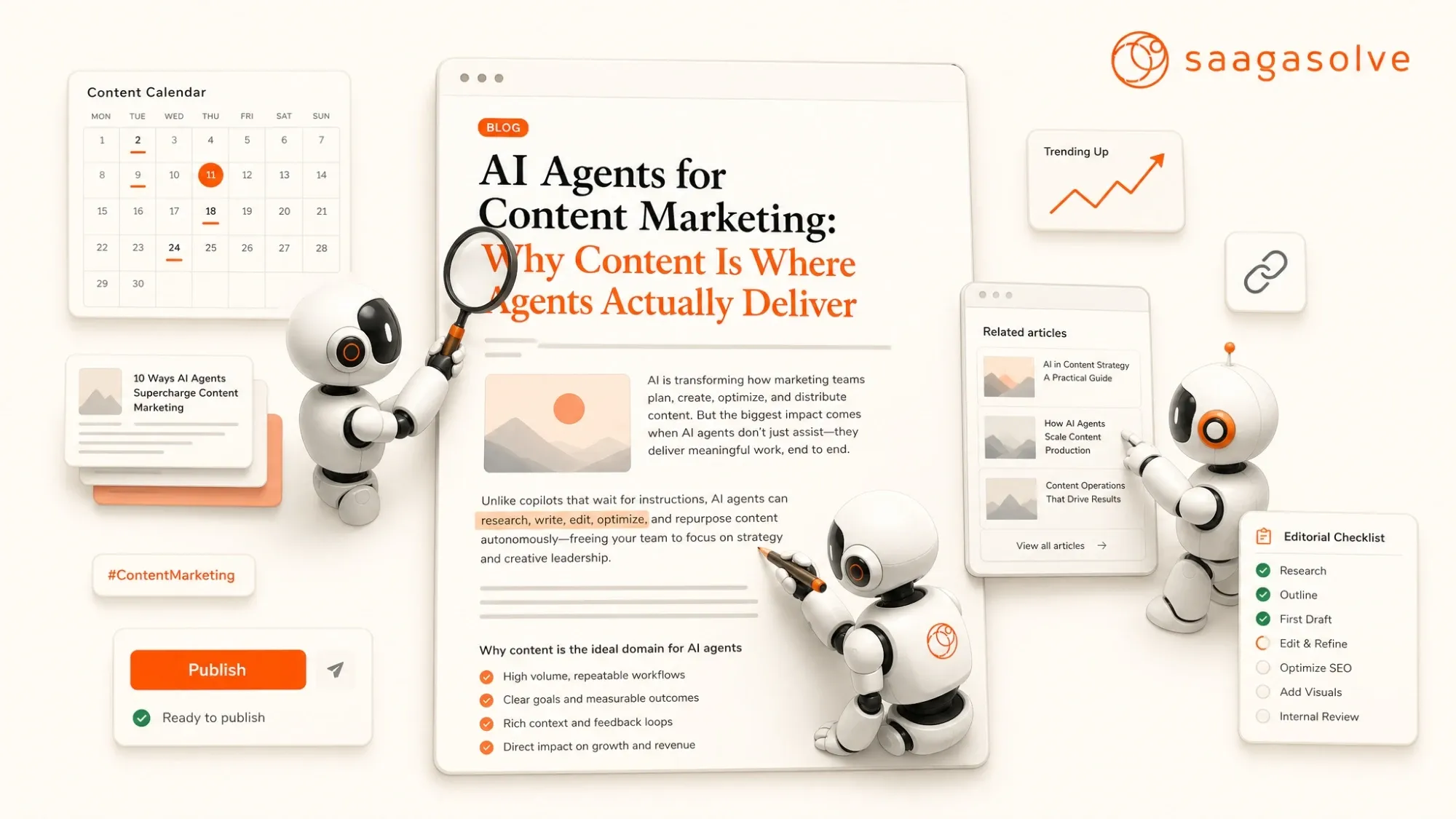
Every marketing team now owns a drawer full of AI tools. A writer here, an optimizer there, a chatbot someone trialed in Q3. And yet the work still moves at the same speed it did in 2023, because a tool waits for a human to operate it. An agent doesn't. It takes a goal, plans the steps, executes them, and reports back.
That distinction sounds like vendor hair-splitting. It isn't. McKinsey's April 2026 analysis of agentic AI in marketing found that agentic systems could eventually power up to two-thirds of marketing activities — and that while roughly 90% of CMOs are experimenting with AI, fewer than 10% have captured end-to-end value from it. The gap between experimenting and delivering is the whole story. Content marketing is where that gap closes first, because content is the one marketing function where the workflow is already defined, the inputs are already digital, and the output can be measured within weeks.
The Problem Isn't Tools. It's Transformation.
McKinsey calls it the “gen AI paradox”: a patchwork of disconnected pilots that each save minutes but never compound. A writer drafts faster. An optimizer scores faster. A researcher summarizes faster. Nothing connects, so nothing transforms.
The numbers back this up from the demand side too. Salesforce's 2026 State of Marketing report found that:
- 75% of marketers now use AI, with personalizing content the top use case
- 78% need more personalized content than they can actually produce
- 88% are optimizing for AI-generated responses — a distribution surface that didn't exist two years ago
Teams need more content, more tailored, for more channels, at a pace that a drawer full of disconnected tools was never going to deliver.
PwC's AI Agent Survey puts the adoption curve in context: 79% of organizations are adopting AI agents in some form, and the functions already using them most are customer service (57%) and sales and marketing (54%). The intent is there. The missing piece is a system that turns intent into a running workflow instead of another tab.
The Content Workflow Is the Spine
The spine holds because every stage of content marketing has a clear input and a clear output. That's exactly the shape agentic systems are built for. Four stages matter.
Creation
This is the stage everyone has already touched, and the stage where McKinsey's research found content-creation pilots running 4× faster. But speed alone is table stakes. The difference between a writing tool and a writing agent is what happens before and after the draft: keyword research that feeds the brief, gap analysis that tells you what competitors rank for and you don't, and a draft that arrives already grounded in that research rather than starting from a blank page. SaagaSolve's Keyword Research Tool and Content Gap Analyzer exist to feed the AI Article Writer. The research isn't a separate errand. It's part of the pipeline.
Humanization and Quality Control
This stage is where most AI content stacks quietly fail. A draft that reads like a draft gets ignored — by readers, and increasingly by the systems that decide visibility. Google has been explicit since 2023 that it rewards helpful, people-first content regardless of how it was produced, and penalizes content made primarily to manipulate rankings. The practical implication: AI-assisted content needs a quality gate that checks for authenticity, not just grammar. SaagaSolve treats this as an integrated workflow stage — the AI Humanizer reworks machine-generated text into natural, human-sounding prose and runs authenticity checking as part of the same pass. It's quality control built into the pipeline rather than bolted on after it.
Human-in-the-Loop Oversight
No credible agent story removes the human. The right framing is division of labor: the agent takes the busywork, the analyst takes the judgment. A person reviews, edits, approves, and owns the outcome. The agent clears the queue. This isn't a compromise — it's the design that makes the output trustworthy enough to publish under your brand.
Distribution and AEO
The newest stage, and the one most teams haven't staffed. With 88% of marketers optimizing for AI-generated responses, content now has to answer questions the way answer engines consume it: structured, direct, citable. Distribution agents handle the formatting, the repurposing, and the monitoring that a human team would do manually across every channel — or, more often, not do at all.
The Proof: One 68-Minute Audit
Claims about agent speed are cheap. Here's one with a paper trail.
In May and June 2026, Wilinski Solutions ran a site audit using SaagaSolve's agents on SAAGA's own website. The manual baseline for the same audit: 16 hours of senior-analyst time, roughly $2,400 at $150 per hour. The agent completed the same audit end-to-end in 68 minutes — about 93% faster — saving $2,230 per audit. The raw platform runtime was 8 minutes. The rest was verification and review, and that part was deliberate.
What the audit surfaced is in the full case study: mobile LCP readings of 8.0–8.8 seconds, and only about 2% of 34,891 backlinks carrying dofollow. Stats verified September 2026.
The study's conclusion is worth quoting in full:
The credible conclusion is not that the agent replaces the analyst. It is that it removes the work that was keeping the analyst from doing the analysis.
That's the pattern across the platform.
Excellent, this tool has transformed the way our agency operates. As an SEO agency, we rolled it out across the entire team and trained everyone to use it. It's already saving us AU$120K per year. — Steven, CEO & Founder of Opollo
I freaking LOVE SAAGA Solve. Most SEO tools force you into their workflow. With SAAGA Solve you can build custom agent workflows for anything you can imagine. It's saving us AT LEAST 15 hours per week. — Laura Cardona, Director of SEO at Dymic Digital
Both quotes say the same thing in different words: the value isn't a clever output. It's hours returned to the team, every week, compounding.
How to Tell a Real Agent From Agent-Washing
Gartner warned in June 2025 that more than 40% of agentic AI projects will be canceled by the end of 2027, and coined the term “agent washing” for vendors rebranding existing automation as agents. Their forecast: by 2028, at least 15% of day-to-day work decisions will be made autonomously through agentic AI — up from zero in 2024. Most of what's sold as an agent today isn't one.
Four tests separate the real thing from the rebrand:
- Does it plan, or does it prompt? A real agent decomposes a goal into steps and executes them in sequence. A chatbot with a nice wrapper asks you to do that decomposition yourself.
- Does it act on your data, or ask you to bring it? Agents need native access to the systems where the work lives. SaagaSolve runs on 60+ native integrations, connected via direct API — the data is already in the platform, not something you pipe in yourself.
- Does it finish the loop? Draft, check, revise, report. If the “agent” stops at the draft and hands the rest back to you, it's a tool.
- Does a human stay in the loop by design? Beware the opposite failure too: full autonomy with no review gate is how agentic projects end up canceled. The credible products make oversight a feature.
One more practical test: the model layer. SaagaSolve runs 150 models live on every plan, with 315 in the catalog — because a real agent needs to route each task to the right model, not lock you into one vendor's strengths and blind spots.
Where This Is Heading
Content is where agents deliver first, but it won't be where they stop. Two frontiers are already visible:
- Performance agents — systems that watch rankings, traffic, and conversion data, then adjust the content plan in response, closing the loop between publishing and results.
- Voice agents — conversational interfaces that brief, review, and direct the content workflow the way you'd brief a colleague.
Both are early. Both extend the same spine. The teams with their content workflow running on agents today will be the ones positioned to switch on the next stage first.
Start Where the Proof Is
The drawer full of tools isn't working, and the market data says why: disconnected pilots don't compound. The content workflow — creation, humanization, human oversight, distribution — is the place to run your first real agent, because it's the place agents prove themselves fastest. SaagaSolve's plans run from free to $129/mo, plus an enterprise program, and the free tier includes 150 models live. It's rated 4.9/5 by 67 users on saagasolve.com.
Two ways in: sign up free and put an agent on your next article, or book a tutorial and see the full workflow — including the Site Health Checker that ran the 68-minute audit — mapped to your stack.